Historical photos and information about the Hafele-Keating experiment
I teach physics, and I love the Hafele-Keating experiment as a way to introduce relativity. Because the experiment has a lot of charisma, it's cool to be able to show students photos of the men and the clocks aboard the plane. I've obtained and scanned copies some of these and posted them here. Below each low-resolution photo is a link to a full-resolution version.
In the course of digging up the photos, I ended up compiling some other links and information. Below the photos I've presented some of these items that might be of historical or pedagogical interest.
Photos
Hafele and Keating with clocks
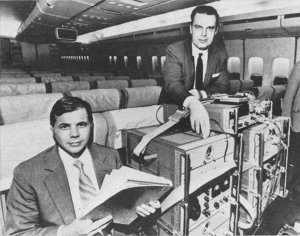
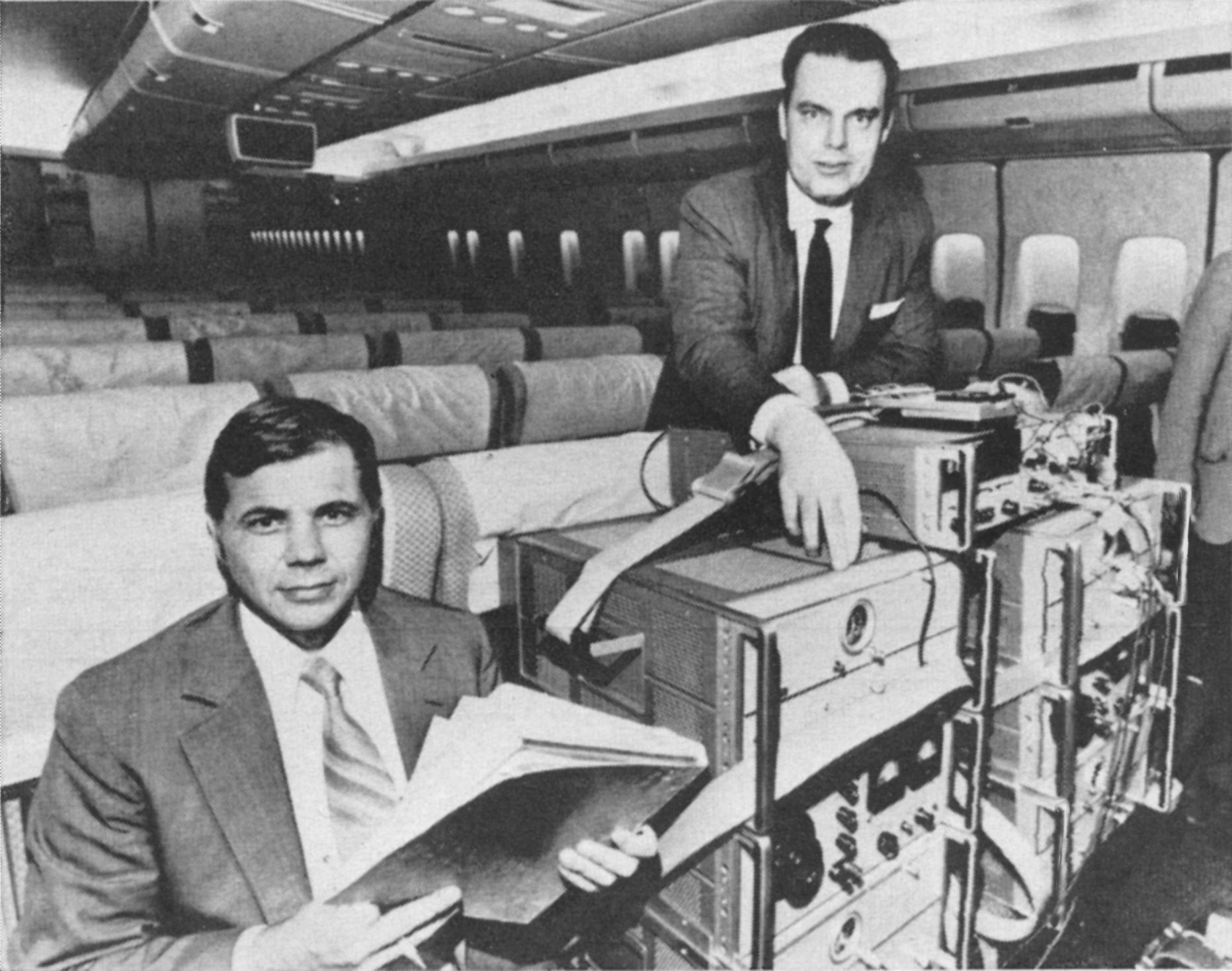
This photo is from Time Magazine, October 18, 1971, where it appeared with "AP" written above the upper right corner. Georgina Brenner, who works for the BBC, has contacted The Associated Press and says, "they have confirmed they do not hold the copyright for that photo. We are now trying to get in touch with Time Magazine and Popular Mechanics, but this is proving difficult." Based on this information, it seems likely to me that Hafele and Keating just took a camera with them, and after being allowed to board early, they rounded up a crew member to take some snapshots. The photos would then be in the public domain because the photographer would not have renewed their copyright as required in that era. In the event that this photo is still copyrighted, it is reproduced here under the fair use exception to U.S. copyright law. Article (paywalled). I have retouched the photo, but that retouching is not copyrightable under U.S. law.
An online listing of errata for early editions of the textbook by Hartle says that the photo (below) of Luther and Dabney had been published with an erroneous caption describing them as Hafele and Keating. Hartle says, "A correct picture of Hafele and Keating [the one shown above] on their initial flight is below. Thanks to Robert Nelson of the Satellite Engineering Research Corporation for pointing out this error and supplying the correct picture." It is therefore possible that the photo was taken by Nelson, or it may be that Nelson simply supplied Hartle with a copy.
Hafele and Keating with clocks and stewardess
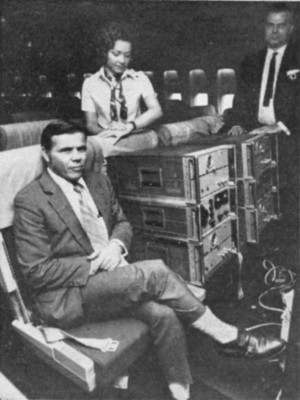
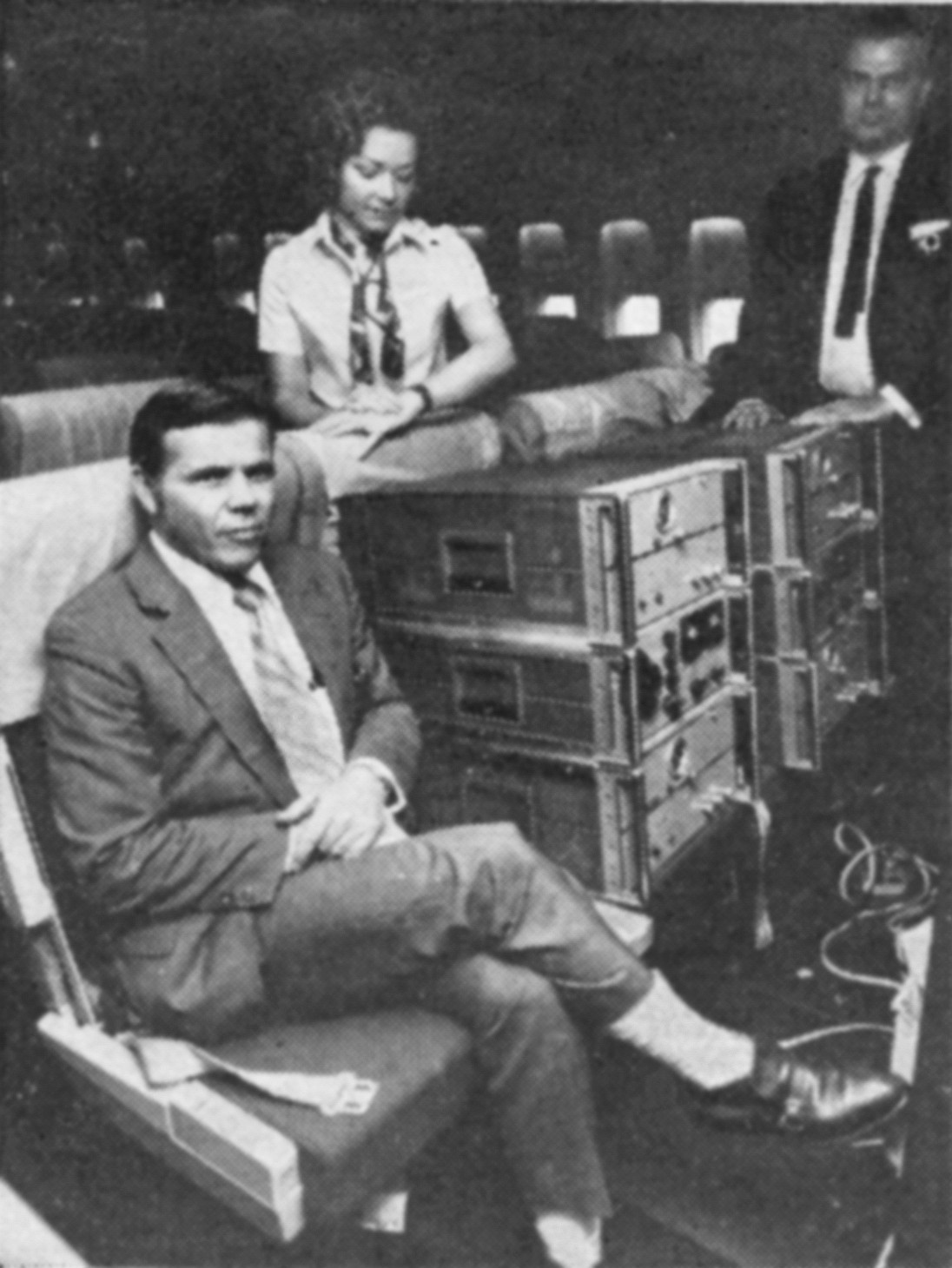
From Popular Mechanics, January 1972, p. 30. Article in Google Books. I don't know the copyright status of this photo. This issue of Popular Mechanics does not give specific photo credits for almost any of the photos in it. If this was a snapshot taken by the crew or another passenger, then it is now in the public domain due to its publication without notice before 1977. If it was taken by a photographer as a work for hire, then it is (c) 1971 Hearst Corporation. If it was taken by an employee of the U.S. Naval Observatory, then it is a public-domain product of the U.S. government. In the event that it is copyrighted, I am reproducing it here under the fair use exception to U.S. copyright law. I have retouched the photo, but that retouching is not copyrightable under U.S. law.
Luther and Dabney boarding plane
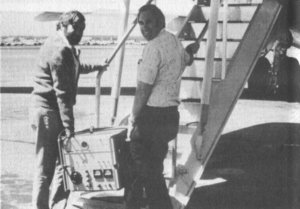
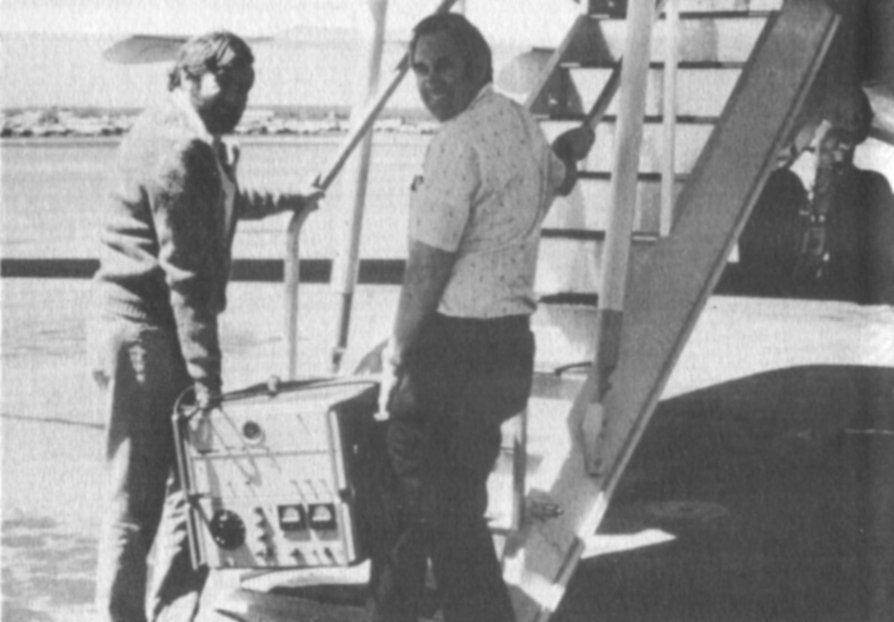
This photo, from the same era as the Hafele-Keating experiment, shows U.S. Naval Observatory technicians George Luther and Bill Dabney boarding a commercial plane with an atomic clock. It is a public-domain product of the U.S. government.
Navy plane and clock used for Alley's Chesapeake Bay experiment
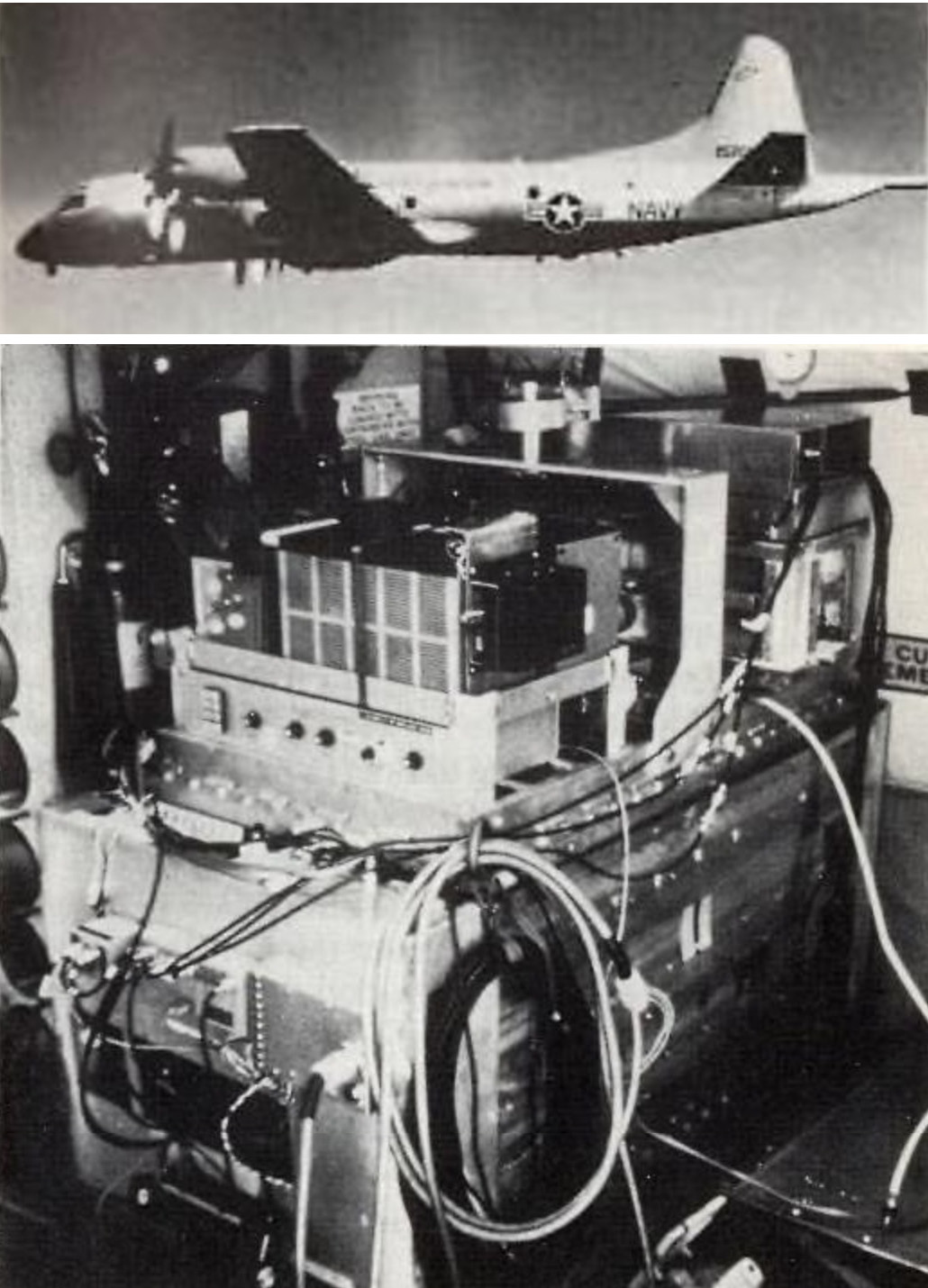
These photos show a plane and set of atomic clocks used in a 1975-6 experiment by Alley et al., which was basically a higher-precision repeat of the Hafele-Keating experiment. Inside the sealed box are three Cs clocks and three Rb clocks. The plane's motion was measured accurately by radar so that the kinematic time dilation could be eliminated. A pulsed laser system was used in order to get a real-time comparison of the flying clocks with an identical set on the ground, thereby measuring the gravitational time dilation at the plane's 9000 m elevation. I'm guessing that the top photo might be public domain, since the plane is a Navy plane. I don't know the copyright status of the bottom one.
Other contemporary accounts in the popular press
- Scientific American, September 1972
- New Scientist, Feb 3, 1972, "The clock paradox resolved"
- C.P. Gilmore, "After 63 years, why are they still testing Einstein?," Popular Science, Dec. 1979, p. 58. An article from later in the decade, describing the golden age of experimental tests of general relativity during the lead-up to the construction of the GPS system.
Scientific papers describing the Hafele-Keating experiment
- Hafele and Keating, "Around the world atomic clocks: predicted relativistic time gains." Science 177 (1972) 166.
- Hafele and Keating, "Around the world atomic clocks: observed relativistic time gains." Science 177 (1972) 168.
- Hafele, "Performance and results of portable clocks in aircraft," PTTI, 3rd Annual Meeting, 1971. This is as far as I know the only scientific paper about the Hafele-Keating experiment that is not paywalled. Only a preliminary analysis of the scientific results is presented, and the focus is mainly on the performance of the clocks. There is a transcript of a Q&A session at the end that provides some nice historical context about the scientific value of the experiment.
Papers by Alley et al.
A group at the University of Maryland led by C. Alley did clock-on-plane experiments similar to Hafele and Keating's, improving the precision and measuring the relativistic effects to about 1% and testing the dependence on variables such as latitude.
- C. Alley, "Proper Time Experiments in Gravitational Fields with Atomic Clocks, Aircraft, and Laser Light Pulses," in Quantum Optics, Experimental Gravity, and Measurement Theory, eds. Pierre Meystre and Marlan O. Scully, Proceedings Conf. Bad Windsheim 1981, Plenum Press, New York, 1983, ISBN 0-306-41354-X, pp. 427363. Includes a photo on p. 415 of Alley's "two-ton Timex" being rolled onto a military cargo plane.
- C.O. Alley, "Introduction to Some Fundamental Concepts of General Relativity and to Their Required Use in Some Modern Timekeeping Systems," in NASA Goddard Space Flight Center Proc. of the 13th Ann. Precise Time and Time Interval (PTTI) Appl. and Planning Meeting, p. 687-724, 1981 (SEE N82-20494 11-36). Contains some muddy reproductions of photos, e.g., on p. 33.
- R.A. Reisse, "The Effects of Gravitational Potential on Atomic Clocks as Observed With a Laser Pulse Time Transfer System," University of Maryland Ph.D. dissertation (May, 1976).
- R.E. Williams, "A Direct Measurement of the Relativistic Effects of Gravitational Potential on the Rates of Atomic Clocks Flown in an Aircraft," University of Maryland Ph.D. dissertation (May, 1976).
- AIP interview with Alley
Other scientific papers of historical or pedagogical interest
- R.F.C. Vessot et al., "Test of Relativistic Gravitation with a Space-Borne Hydrogen Maser," Physical Review Letters 45 (1980) 2081. This paper describes the Gravity Probe A experiment, in which a suborbital probe measured gravitational time dilation on an atomic clock to about 0.01%.
- L. Briatore and S. Leschiutta, Evidence for the earth gravitational shift by direct atomic-time-scale comparison, Il Nuovo Cimento B, 37B (2): 219 (1979).
- S. Iijima and K. Fujiwara, An experiment for the potential blue shift at the Norikura Corona Station, Annals of the Tokyo Astronomical Observatory, Second Series, Vol. XVII, 2 (1978) 68. An article reproducing a graph of their data.
- Chou et al., "Frequency Comparison of Two High-Accuracy Al+ Optical Clocks, 2010. This is the first experiment I know of in which kinematic time dilation was observed using an atomic clock, without any gravitational time dilation.
- nontechnical description of the Chou experiment
Modern hobbyist Tom Van Baak has done a truly amazing mountain-valley experiment of this flavor with a second-hand atomic clock in the family minivan. There is a web site and mailing list (Time Nuts) for people who do high-precision timing experiments for fun, and they have a museum with old photos and documentation.
I would be grateful to anyone who could e-mail me with any of the following:
- Any biographical information about Hafele or Keating. All I currently know is where they were employed in 1971, that Dr. Hafele later worked at Christopher Newport University, and Dr. Keating's approximate date of death in 2004-2005.
- Related historical photos that are in the public domain.
- Any images of high educational or historical interest from the Iijima paper or the Reisse and Williams theses (which I don't have access to).
- Information about the copyright of the photo that appeared in Popular Mechanics.